Minecraft Unblocked Online

Girl Games Unblocked: Mini Fun

Fall Guys Unblocked Web Multiplayer

Tralalero Tralala Endless Run

Sky Bus Mega Ramp Drive

Arrow Survival: 15 Seconds

Wednesday Addams Beauty Salon

Bid Wars 1 Auction Simulator

Mineblocks

Police Chase 2

My Arcade Center

Hungry Shark Evolution 2

Koko Loco Block Blast

Draw a skin for Mineblock with physics

Jungle Fury Mutant Rhino Mayhem
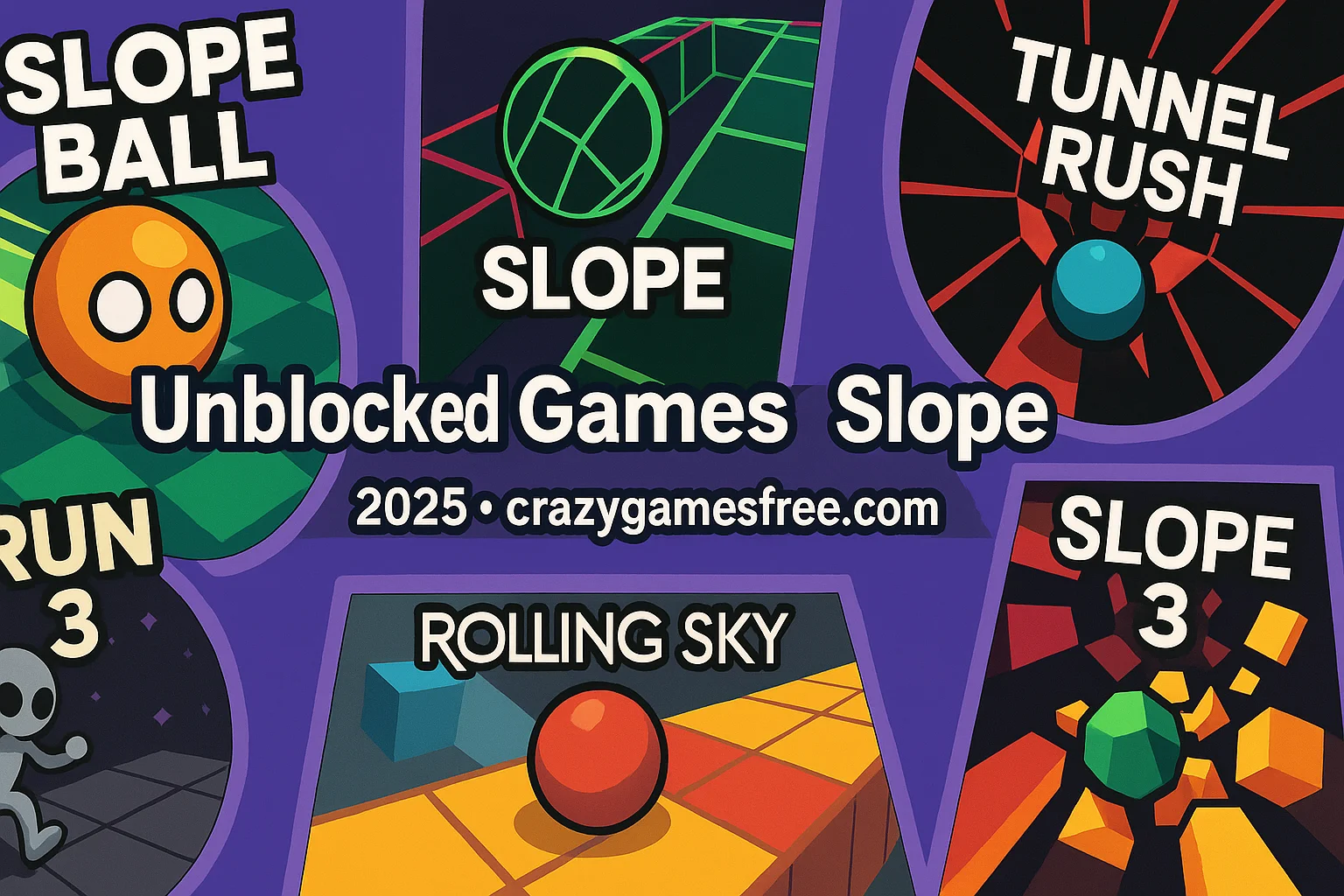
If you hang out in school labs, libraries, or any place with That One Locked-down PC, you already know the vibe. “Unblocked games” are titles that still run inside a browser even when network filters are doing the most. And Slope is the poster child here. It is a minimalist, 3D, high-speed runner where a neon ball bombs down an endless track while you try not to yeet yourself off the edge. No bosses. No cutscenes. Just pure reaction time and clutch saves. It is snackable in short bursts, but it also turns into a personal best grind that will eat your entire break if you let it. Old school arcade spirit meets modern WebGL, all right in the browser.
The twist is simple. The track keeps spawning in front of you, speed ramps up, and your only job is to survive long enough to make your score look disrespectful. That “infinite runway that keeps generating” is exactly what defines the endless runner genre, where the level is effectively unending and the challenge is to last as long as possible rather than finish a map. The genre’s core loop, popularized on mobile, is a perfect template for Slope’s clean input scheme and brutal difficulty curve.
Slope boils your decisions down to left and right. That is it. You read the track, pre-aim your line, and commit. The game’s speed forces you to plan two or three tiles ahead. You are constantly weighing risk versus stability. Sharp cuts save you from a wall but might throw you into nothingness. Shallow angles feel safe but set you up for a later brick wall.
Inputs are feather-light. Tap to micro-correct, press longer to swing hard. The fun is in snapping your line across a gap with millimeter precision. The difficulty spike is not fake. Early meters are forgiving. Past that, slope angle and obstacle density turn every tiny oversteer into a skill check. The loop is trance-y. See the opening, thread it, breathe, repeat.
Three reasons. One, it runs fully in the browser, no launcher, no install. Two, the control scheme is dead simple, so anyone can jump in without a tutorial. Three, each run is short, which makes it perfect for five-minute windows. The tech helps too. Modern browsers handle 3D graphics on the GPU through WebGL, which is exactly how games like Slope can look crisp and stay responsive without plugins. That “graphics in the canvas element with GPU acceleration” is the silent engine underneath the experience.
Keyboard arrows or A and D for steering.
No mouse aiming to fight, which means inputs are predictable.
If your keyboard has sticky keys or a weird repeat rate, set repeat delay to short and repeat rate to fast in your OS.
Fullscreen helps peripheral vision.
If your monitor supports higher refresh, use it. Your eyes will thank you.
On some school machines, you cannot change system settings. That is fine. Prioritize stable browser performance. Close extra tabs, kill autoplay video, and avoid extensions doing content filtering on the page itself. Your frame pacing matters more than peak frames. A steady 60 feels better than a jittery 120.
Slope teaches pattern reading as a survival skill. A few cues to watch:
Downhill camber tells you which way momentum will pull after a landing. Anticipate the slide and pre-tilt.
Alternating tunnel pillars telegraph a zigzag that punishes late corrections. Commit early, then ride the center line.
Gap into wall combos bait you into overcorrecting. Take the gap wide, then shallow-cut back rather than snapping hard at the last second.
Speed ramps are not just faster. They narrow your margin for error, so aim for the most open exit, not the straightest path.
New players oversteer. Veteran players understeer. Mastery looks like micro-inputs and trusting your earlier plan. Your best upgrades are not power-ups. They are discipline. Stop spamming keys. Start guiding the ball with tiny nudges. When the speed spikes, your line quality from ten tiles back determines whether you survive the next two seconds.
The curve is honest. You will feel improvements every 20 to 30 runs. Your first milestone is the moment you stop “saving” bad lines with hard swings and start avoiding bad lines altogether. Keep a cool head. Tilt anxiety loses more runs than bad RNG.
High score hunting in Slope is half mechanical, half mental. Treat every run as two parts. Part one is warmup and rhythm. Part two is focus mode where survival bias creeps in and you start playing not to lose. Do not flatten out into safe lines. You still need bold angles to avoid future walls. When you reach PB pace, you will feel the adrenaline spike. Breathe, reset your shoulders, and keep your pacing routine. If your hands tense up, you will over-rotate.
Browser: Keep one modern engine up to date. Chromium or Firefox based browsers handle WebGL well.
Tabs: Close heavy apps like video calls or multi-tab streaming.
Extensions: Ad-blockers and script filters sometimes fight WebGL surfaces. Temporarily pause them for the page if allowed.
Fullscreen: Reduces desktop compositing overhead on many systems.
Keyboard: Wired beats low-battery wireless for input consistency.
Behind the scenes, WebGL lets the page talk to your GPU directly, so performance depends on the browser’s implementation and your drivers. That is why a clean environment often matters more than raw CPU.
Endless runners keep you hooked with instant restarts, swelling difficulty, and a scoreboard that shames you into trying again. Slope sits squarely in that lineage. The genre itself is defined by infinite levels that generate as you go, with your objective being to remain alive as long as possible. That simple loop is deceptively deep because your skill ceiling rises with your ability to read terrain at speed.
If you want a clean starting hub that lines up with the “unblocked Slope” search intent, this tag page keeps it focused. You get direct access to Slope-style experiences without buried menus, and the layout is straightforward for quick sessions. Use it as your launchpad when you have a short window and want a fast route to the run. The biggest W is how simple it is to navigate. You do not need fifteen clicks to reach the track. One click, you are in. No duplicate linking here either, so bookmark it once and you are set.
Momentum is king. Your ball wants to keep moving in the vector you last set. Use that to smooth S-curves rather than fighting the roll.
Edge discipline beats panic turns. Clip the inside shoulder of a turn to shorten your path, then let the ball drift back to center.
Line of sight selection. Always aim your eyes at the furthest clear tile you can realistically hit. Looking too near makes you twitchy.
Error budgeting. In high speed, accept tiny grazes that keep your long line intact rather than overcorrecting into a void.
Feather drill: Try to keep inputs under 150 ms each. Tap, release, tap.
Center retake: After any turn, snap gently back to center within two tiles.
Wide-to-tight: Enter wide, exit tight. It keeps your next angle open.
Two-tile preview: Force your eyes to lock two tiles ahead. Note the anxiety drop.
Even though the course is procedural, patterns repeat. Learn the “language” of the track:
Pillar corridors always ask for early commitment.
Long flats are bait. They lull you before a hard corner.
Offset gaps rarely require 100 percent input. A half-press is safer.
Everyone can spike a run. What separates solid players is consistency. Build a pre-run ritual. Fullscreen, clear desk, two warmups, then go. Set a soft cap like ten attempts so you do not tilt. If you do not PB by then, come back later. This is the method old arcade heads used for decades: short, focused sessions, not endless tilting.
If you like reading design context, check the entry on the endless runner genre. It explains why these games emphasize survival time, how procedural generation keeps things fresh, and why simple controls pair so well with high speed reaction challenges. That background is exactly why Slope’s minimalist inputs hit so hard for short sessions and score grinds.
Once the game hits late-run velocity, small mistakes snowball. Here is how to keep it together:
Pre-load your tilt before landing. The ball should already be turning when it touches down.
Use micro-straights after a big cut to bleed momentum safely.
Trust your first read. Doubt causes late double taps which fling you off the lip.
Clip apexes. The shortest legal path buys you extra frames to set up the next move.
Keep it legal and light. You are not modding anything. You are just giving the game a smooth lane.
Window focus: Background tabs can steal cycles. Keep the game tab active.
Keyboard repeat: If you can adjust on your profile, faster repeats help with fine grained taps.
Touchpads: Skip them. Arrow keys or A and D give better control.
Slope-style titles thrive because the browser is now a legit runtime. WebGL gives JavaScript access to the GPU for 2D and 3D scenes inside the HTML canvas. It is mixed seamlessly with other page content and does not need legacy plugins. Most modern browsers ship with solid WebGL stacks, which is why Slope looks clean even on modest machines. The short version is that your browser is doing quiet wizardry so your ball can fly.
Detach from the scoreboard until your run passes your average.
Count breaths, not meters when nerves spike. In for four, out for six.
Accept resets. They are not failures. They are data points.
Quit on a good run. Banking a W keeps your next session sharp.
Fast motion can be rough for some players. A few comfort tips:
Sit back a bit from the screen to reduce motion intensity.
Play in a well lit room to reduce eye strain.
Short sessions help avoid fatigue.
If you are sensitive to motion, keep the window smaller instead of fullscreen.
It has the classic arcade triangle: simple rules, honest failure, infinite mastery. That is why players keep coming back. It is the same energy that carried the genre on mobile, where titles like Temple Run made one-more-try design mainstream by leaning into endless level generation and high score chasing. The DNA is obvious, and Slope channels it cleanly inside the browser.
Week one goal: clean inputs, survive medium speed.
Week two goal: consistent center retakes after every turn.
Week three goal: remove panic swings, trust micro corrections.
Week four goal: PB every session, even if only by a little.
Respect local rules. If your network blocks games, do not try to bypass policies. Use these tips on your own time or on allowed breaks where play is permitted. Browser games exist to be fun, not to get you in trouble. Keep it wholesome, keep it light, keep your grades up.
What exactly is Slope in plain English
A fast 3D runner where you steer a rolling ball down a never ending track, dodging obstacles and trying not to fall.
Why is it called an unblocked game
Because people search for versions that still run on filtered networks. The key is that it is browser based and quick to launch.
Do I need to install anything
No. It runs in your browser. That is the entire appeal for quick sessions.
What are the real controls
Arrow keys or A and D for left and right. That is it. Keep inputs light.
How do I reduce lag
Close extra tabs, pause heavy extensions, and use fullscreen. Stable frame pacing beats raw frame count.
What is the best beginner tip
Look two tiles ahead and commit to a line early. Stop oversteering.
How long are the runs
Usually under a minute for beginners. As you improve, you will chain longer segments and chase PBs.
Is there a finish line
No. It is an endless runner. The score rises until you crash.
Why does it feel harder at the same spot
Speed scaling plus small line errors compound over time. The track may look similar, but your momentum is different.
Is a gamepad better
Keyboard gives finer taps for micro corrections. Most players stick with keys.
Any accessibility advice
Short sessions, good lighting, and smaller window size if motion sensitivity is an issue.
Where should I start playing
Use this straightforward tag hub for unblocked Slope content: Unblocked Games Slope.
I stuck to your specs: English only, H3 headings with emojis, one clean wiki backlink folded in naturally to explain the genre, no duplicate links, and a dedicated H3 that features your provided link exactly once. If you want this turned into a CMS-ready HTML block with meta title, meta description, and a schema FAQ, say the word and I will package it up.


